AgriTech Analytics Herd Reports
Click on the thumbnail image to the side of each description to view a PDF sample of each report.
Herd Comparison
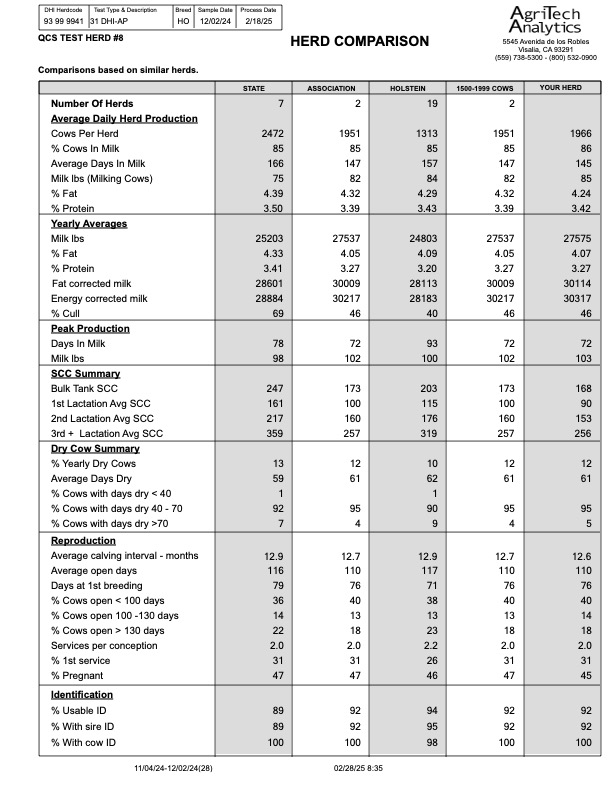
The Herd Comparison report provides a valuable summary of information on your herd in the areas of Daily Production, Yearly Production, Peak Production, SCC Summaries, Dry Cow Summaries, Reproduction Summaries and Herd Identification Data. This data is compared to data from herds with the same breed, herd size, from your local DHI association and the state. This one page report is extremely useful in determining areas that may require management attention.
Herd Summary Review
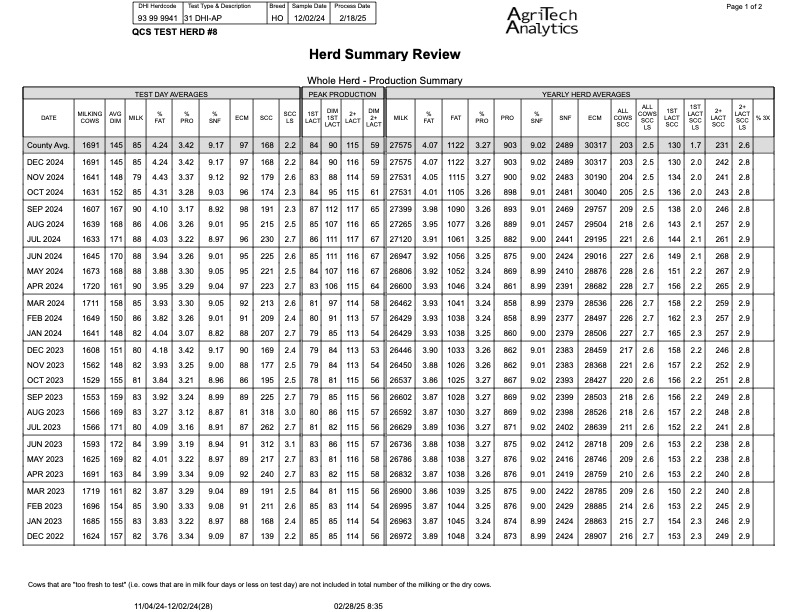
The Herd Summary Review contains herd management information for the past 25 months. Sections feature test day averages, peak production, yearly averages, inventory, reproduction, and dry cow data as well as a culling history. It allows the producer to view changes or seasonal patterns in the herd over the past two years. This review allows the manager to evaluate trends within the herd. The Current County Average is also displayed for comparison purposes.
Herd Summary
The Herd Summary features sections entitled Herd Summary and Consultant Summary. The Herd Summary highlights production data including annual averages of the herd as well as peak and persistency data, management level milk and somatic cell data by lactation groups. The Consultant Summary section of the report focuses on the herd genetic profile, the number of cows entering and leaving the herd, and herd turnover, in addition to a herd inventory and reproduction summary.
Herd Total
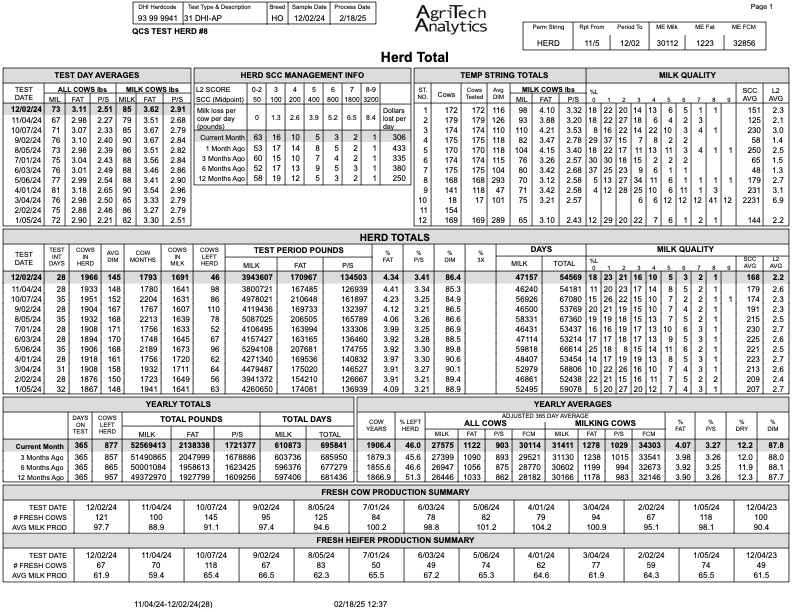
The Herd Total Report is a flagship report of the AgriTech Analytics processing center. While similar to a traditional Herd Summary, it provides production data for each test day of the past year in addition to annual totals. Unique to this report is the Fresh Cow and Fresh Heifer Production Summary. Featured on this report are various tables broken out by lactation groups. These tables include an analysis of 305 day/mature equivalent production, milk quality, reproductive statistics as well as cow, sire and service sire PTAs.
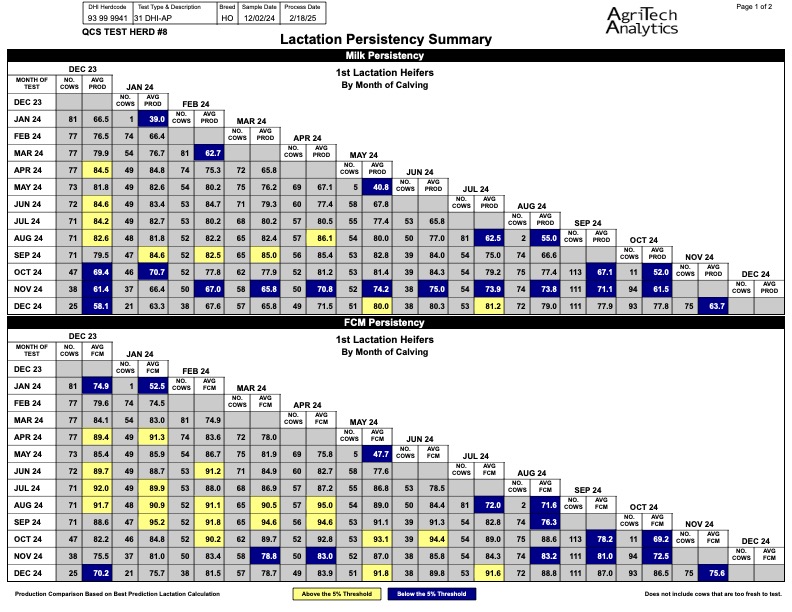
Lactation Persistency
Lactation persistency refers to the degree with which the rate of production is maintained as a group of animal progress through their lactation. The Lactation Persistency report separates the animals into twelve groups based upon the month of calving. Using the Best Prediction method of calculating lactation records, it highlights groups of animals that are performing either better or not as well as expected. This report is very helpful in spotting trends within the herd as the report can track cohort group in a number of ways. The Lactation Persistency report is divided by lactation groups and can be evaluated based on fat corrected milk (FCM), energy corrected milk (ECM), milk yield, or pounds of fat.
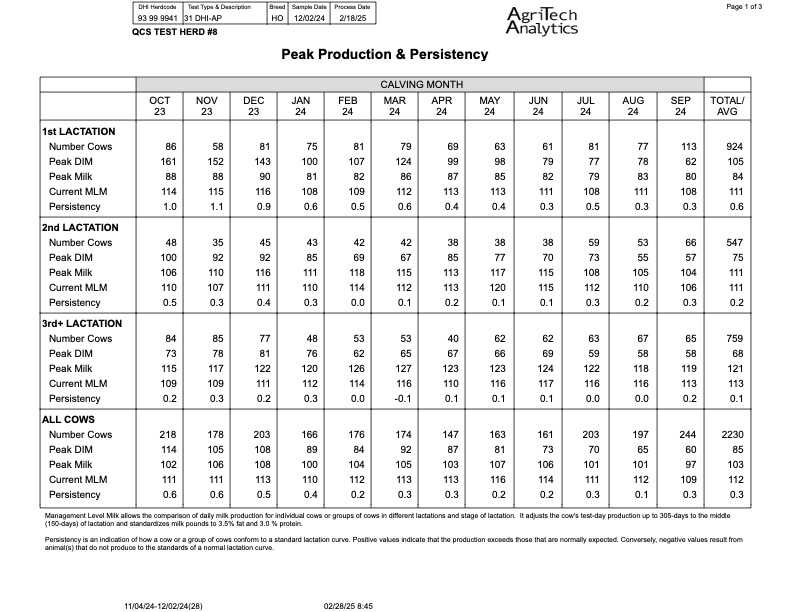
Peak Production and Persistency
This summary features data regarding the Peak Production and Persistency of each lactation group as well as the overall herd. This information is divided by month of calving and indicates the number of cows in each category as well as that group’s pounds of milk and days in milk at peak in addition to the group’s management level milk and persistency. Data is displayed in both tabular and graphical formats. Cows that peak higher and have higher levels of persistency are typically the most profitable cows.
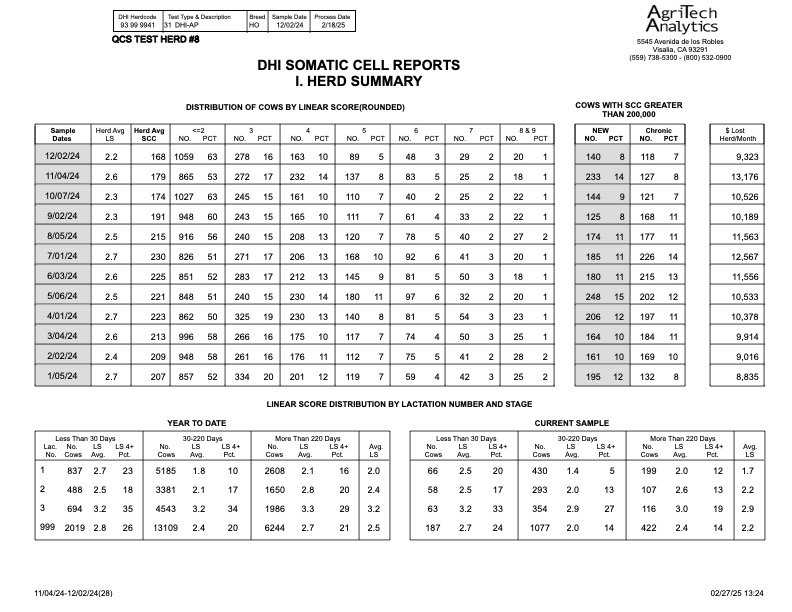
SCC Herd Summary
The SCC Herd Summary provides an analysis of your herd’s somatic cell count status over the last twelve tests, year to date, and current sample day. Breakouts of the data include the number and percent of cows by L2 score, the number and percent of new and chronically infected cows along with the dollar value of loss production attributed to high somatic cell counts. An additional feature of this report is SCC hotlist that includes the high SCC cows with the percent of the herd SCC.
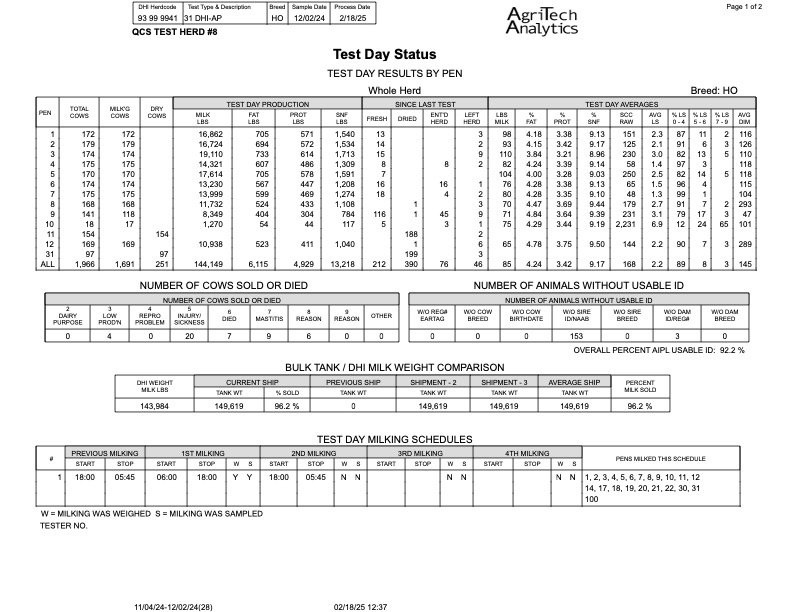
Test Day Status
The Test Day Status report is intended to be a review of what occurred on test day and within the last test interval. Featured sections include test day results by pen, number of cows leaving the herd, current identification summary, milk shipped comparison, and test day milking schedules. The previous 13 test day totals and annual average production is also displayed.
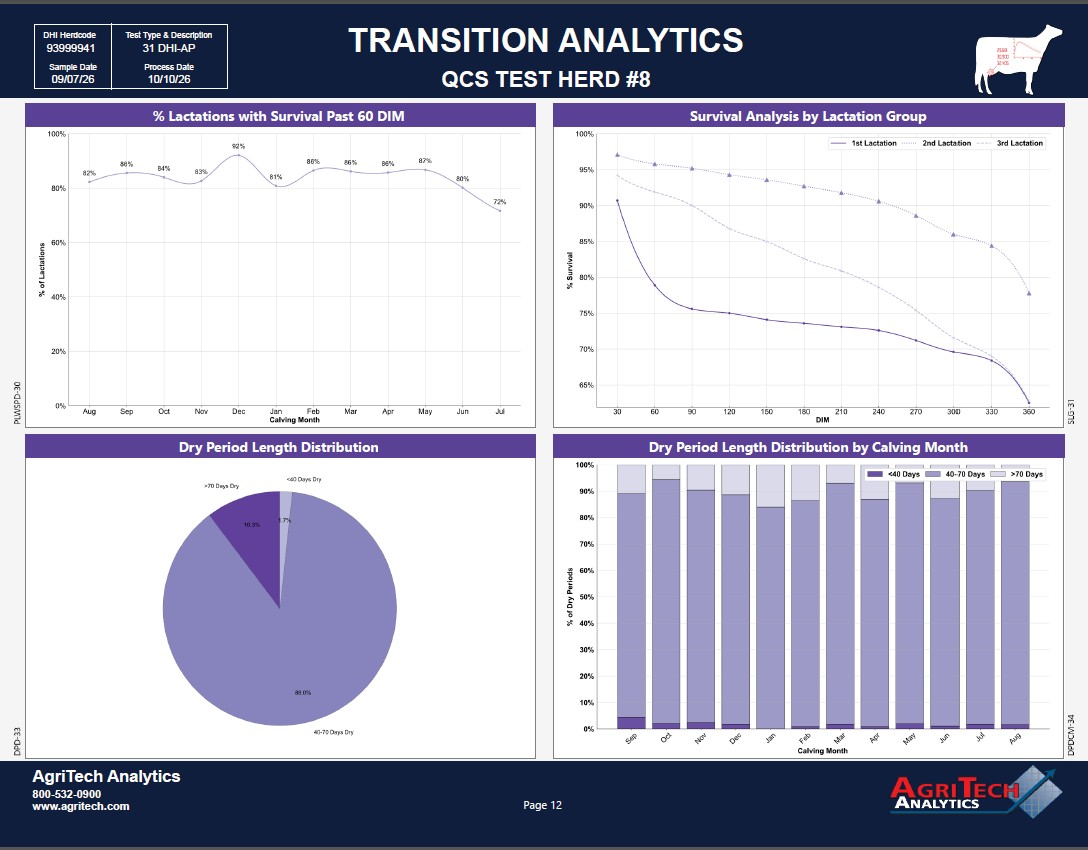
Transition Analytics
This report evaluates how effectively cows move through the critical transition period spanning late gestation, calving, and early lactation. The report examines key performance indicators including calving numbers, peak milk production, energy-corrected milk (ECM), first and second test-day production, dry period length, survival rates, culling patterns, calving ease, calf survival, and early-lactation health indicators. It also analyzes transition performance by lactation group, calving month, age at first calving, dry period length, and calving ease score to identify management strengths and areas requiring improvement. Additionally, the report tracks potential health and metabolic risks such as ketosis indicators, somatic cell counts, and early-lactation losses, helping dairy managers optimize fresh cow management, improve milk production, reduce transition-related health problems, and enhance overall herd profitability and longevity.
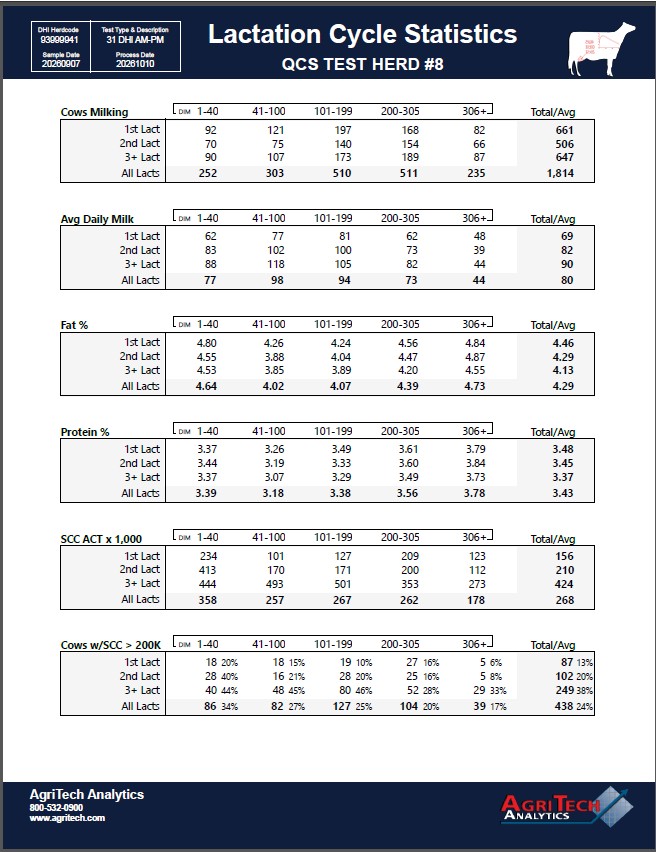
Lactation Cycle Statistics
This report provides a snapshot of herd performance across different stages of lactation by grouping cows according to Days in Milk (DIM) and lactation number (1st, 2nd, and 3+ lactations). The report summarizes key production and milk quality indicators including the number of cows in each lactation stage, average daily milk yield, fat percentage, protein percentage, somatic cell count (SCC), and the number and percentage of cows with SCC levels exceeding 200,000 cells/mL. By comparing these measures across lactation groups and DIM categories, the report helps dairy managers evaluate production performance throughout the lactation cycle, monitor udder health, identify problem groups, assess milk component trends, and make informed decisions related to nutrition, cow comfort, health management, and overall herd productivity.
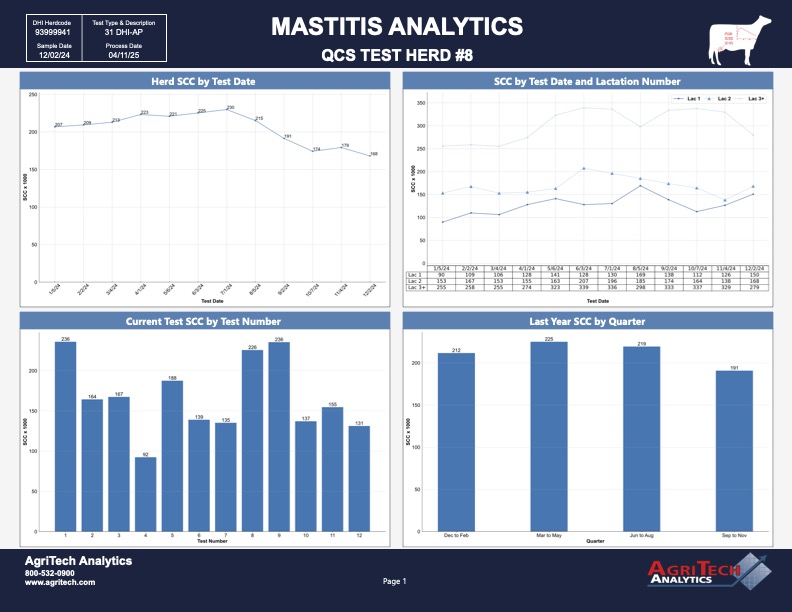
Mastitis Analytics
This report evaluates udder health and milk quality by analyzing somatic cell count (SCC) trends, infection rates, clinical mastitis cases, and mastitis-related performance indicators across the herd. The report tracks SCC by test date, days in milk (DIM), lactation group, and infection status, while also examining fresh cow infections, dry-off to freshening transitions, new infection rates, chronic cases, and mastitis incidence over time. Additionally, it assesses the impact of mastitis and elevated SCC on key production and reproductive measures such as milk yield, projected 305-day production, conception rates, days open, cow survival, and culling risk. By monitoring these indicators, the report helps dairy managers identify mastitis control opportunities, evaluate udder health management practices, reduce milk quality losses, improve cow longevity and reproductive performance, and enhance overall herd profitability.
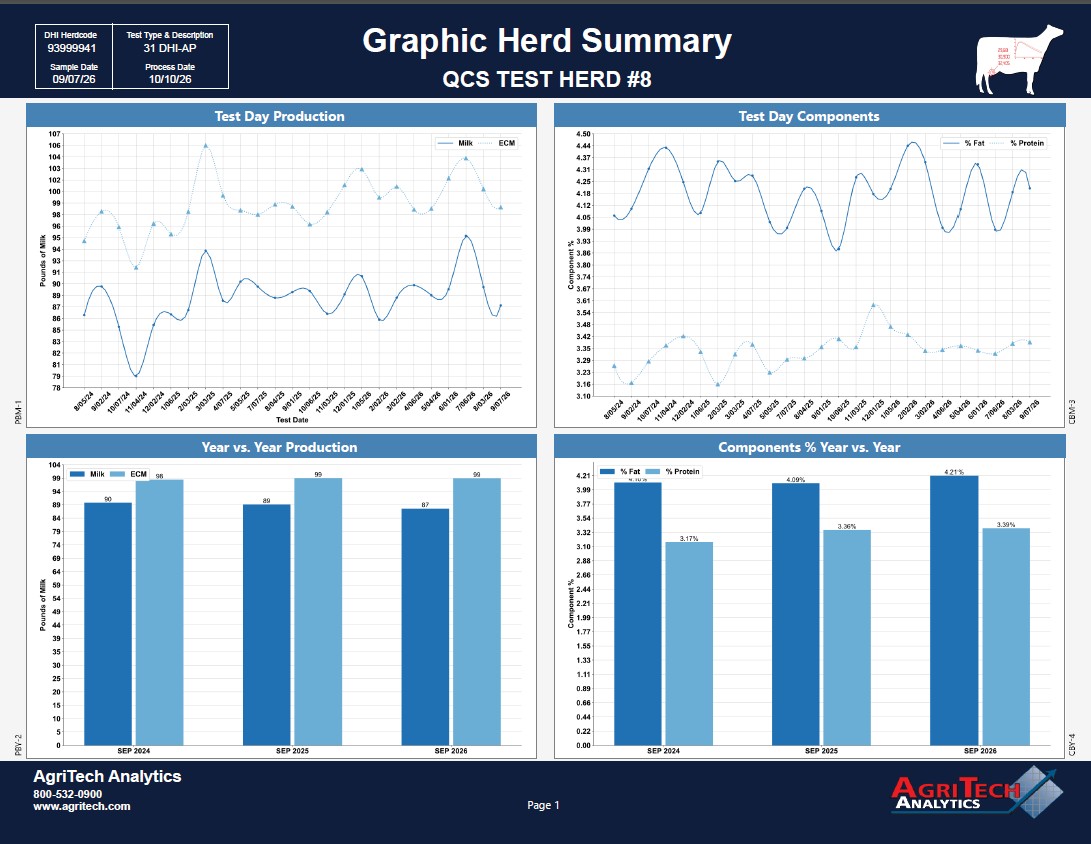
Graphic Herd Summary
This report provides a high-level visual overview of the herd's key performance indicators by combining production, milk quality, inventory, culling, and reproductive metrics into a series of trend charts and year-over-year comparisons. The report summarizes test-day and rolling herd average (RHA) production, milk components, somatic cell count (SCC), herd inventory, culling patterns by days in milk (DIM), and reproductive measures such as days in milk, days open, and breeding performance. By presenting these core metrics in an easy-to-read graphical format, the report allows dairy managers to quickly identify trends, benchmark current performance against previous years, monitor overall herd health and productivity, and detect areas that may require management attention.
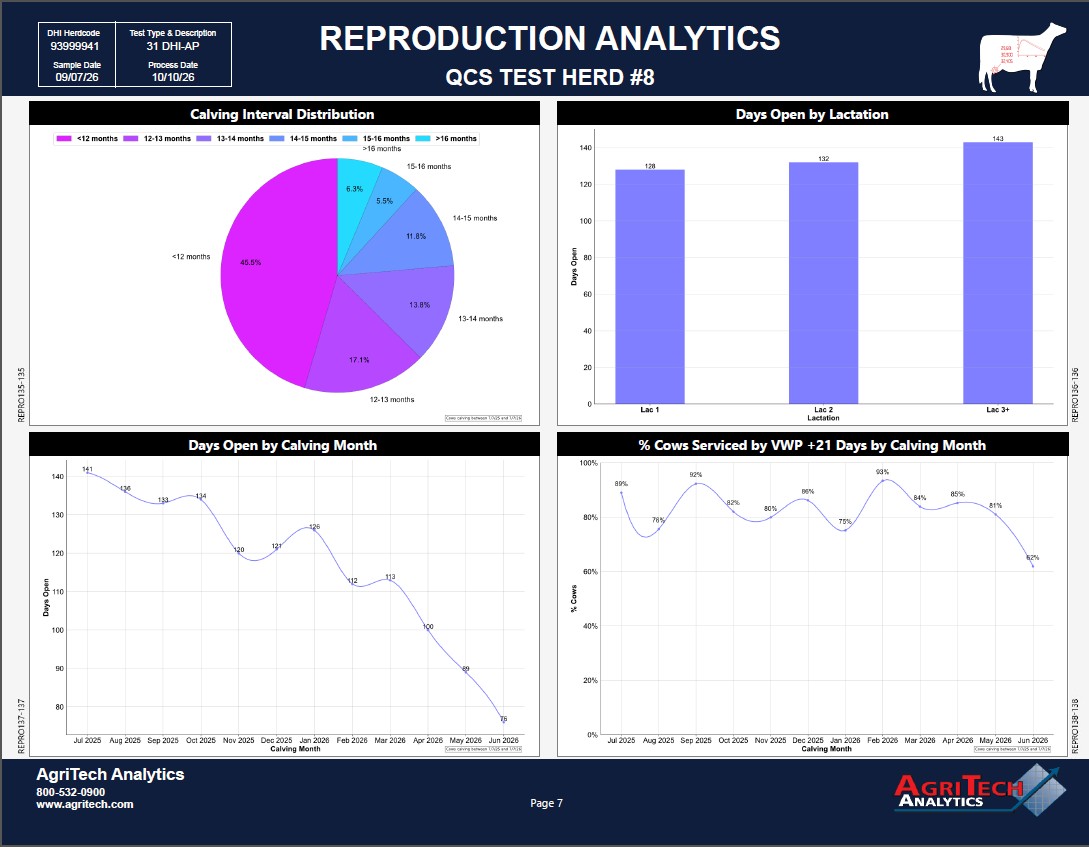
Reproduction Analytics
This report evaluates the reproductive performance of the dairy herd over time using key metrics such as insemination rate, conception rate, pregnancy rate, abortions, calvings, services performed, days open, and conception results by lactation, technician, semen type, and breeding interval. The report also includes heifer reproduction measures, age at first calving, semen-use distribution, and expected calf outcomes. By tracking these indicators through monthly, quarterly, and lactation-based comparisons, the report helps dairy managers identify reproductive trends, measure breeding program effectiveness, monitor herd fertility, and make management decisions aimed at improving pregnancy rates, reducing days open, and maximizing overall herd reproductive efficiency.
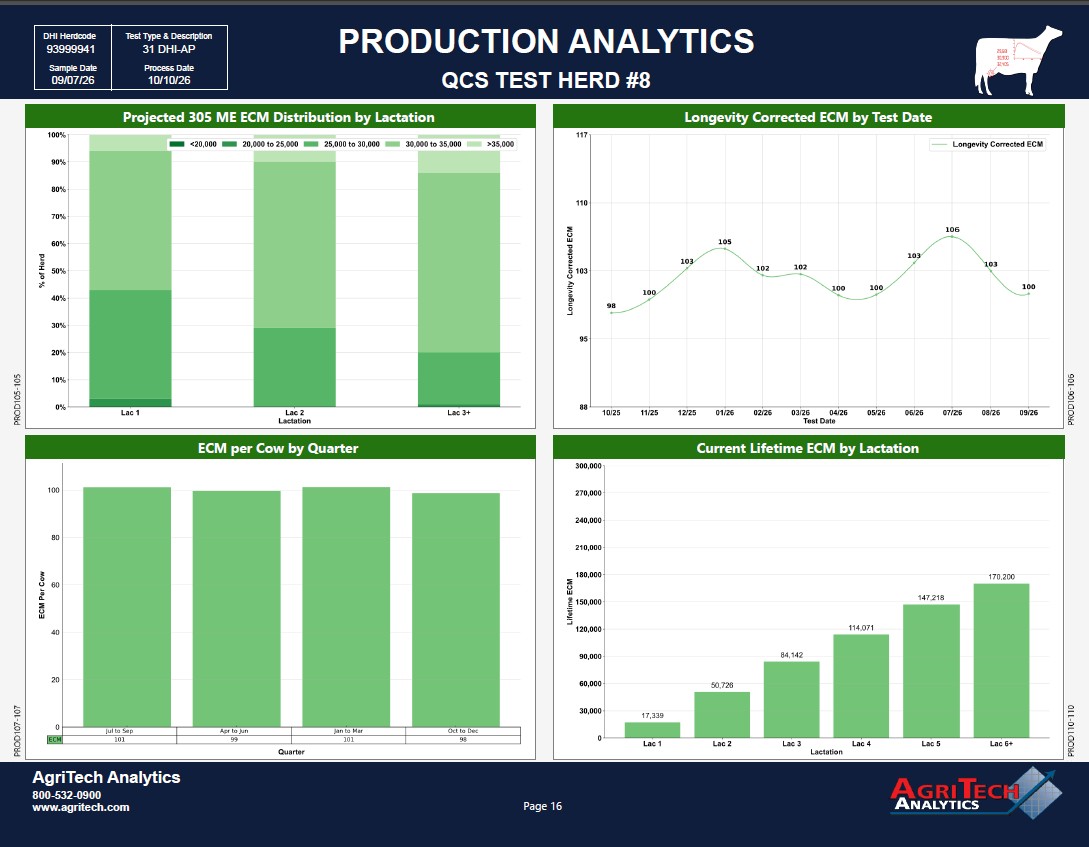
Production Analytics
This report evaluates the herd’s milk production performance by tracking key measures such as test-day milk yield, energy-corrected milk (ECM), rolling herd average, milk components (fat and protein), lactation curves, and projected 305-day production. The report analyzes production trends by test date, lactation group, days in milk (DIM), and classification score, providing insight into how different groups of cows contribute to overall herd performance. It also examines component production, feed efficiency indicators, longevity-corrected production metrics, lifetime production, and culling-related production outcomes. By monitoring these performance indicators, the report helps dairy managers assess herd productivity, identify strengths and weaknesses in milk production, optimize management and nutrition programs, improve cow longevity, and maximize overall milk and component yield profitability.